Here’s an overview of the Best 3d Printer that we’ll explore today:
The market for 3D printers aimed at miniature enthusiasts has evolved rapidly, moving from hobbyist curiosities to reliable production tools for tabletop figures, terrain, and cosplay props. For miniature work, resin MSLA printers excel at fine detail and smooth surfaces, while compact FDM mini printers offer accessible workflows and material versatility. This article tests five models spanning a $139.99 to $249.00 price range to help buyers match a printer’s strengths to their needs—whether you’re painting highly detailed figurines, producing small batches of one-off minis, or simply learning the craft. Our methodology combines out-of-the-box usability assessment, print quality observations on standard miniatures, ease of resin handling or filament management, maintenance considerations, and real-world value in terms of upgradability and ongoing material costs. The products covered are representative of the brands ELEGOO, Entina, MALYAN, Creality, and FLASHFORGE, with a mix of resin MSLA and FDM options to reflect current market choices.

1. Creality Resin 3D Printer for Kids
- Brand: Creality
- Manufacturer: Creality
Overview: The HALOT R6 from Creality is positioned as a compact, beginner-friendly resin MSLA with an integrated light source and a 2K 6.08-inch LCD, designed for easy setup and reliable first prints. Its small footprint (~4.25 kg) and orange-coated top cover for UV shielding emphasize safety and space efficiency, while the flatness of the build plate and a high-precision Z-axis guide aim to reduce initial failures. It supports a one-click workflow via HALOT BOX and Creality Cloud, with optional remote monitoring via a USB-connected webcam, which is attractive for beginners who want minimal setup friction.
Performance-wise, the R6 benefits from a uniform light source and improved adhesion through a flat build plate and a precise Z-axis system, contributing to smoother layer transitions on miniatures. However, as a 2K MSLA, the level of detail is slightly lower than 4K rivals, which matters for ultra-fine figurines. The integrated ecosystem (HALOT BOX and Creality Cloud) provides convenience for model discovery and one-click printing, but ongoing model library access and software updates may influence long-term value. The printer’s weight and small form factor make it a good candidate for desk use or integrated hobby spaces, though resin handling remains a soft requirement for safety and post-processing.
Pros
- Compact, space-saving design with safe UV shielding
- Integrated one-click workflow via HALOT BOX and Creality Cloud
- Improved printing stability due to high-precision Z-axis guidance
- Relatively light for a resin printer, easy to move
Cons
- 2K resolution limits extreme miniature fine detail compared with 4K options
- Resin handling, curing, and post-processing remain mandatory and potentially messy
- Ecosystem may steer users toward Creality’s proprietary software and model ecosystem

2. FLASHFORGE Adventurer 5M 3D Printer with Fully Auto Leveling
- Brand: FLASHFORGE
- Manufacturer: FLASHFORGE
Overview: The Adventurer 5M is FLASHFORGE’s high-speed, auto-leveling FDM printer aimed at rapid prototyping and efficient miniature printing. It uses a CoreXY all-metal frame and claims extremely fast travel speeds, along with a 280°C direct extruder and detachable nozzle system for quick swaps. The 220x220x220 mm build volume sits in the sweet spot for small to medium miniatures and terrain pieces, while the app-based real-time monitoring adds convenience for busy hobbyists who want to stay informed without being tethered to a computer.
In use, the 5M excels at repeatability and quick setup courtesy of automatic bed leveling and a robust mechanical structure. The 600 mm/s max speed is impressive on paper and translates to faster print cycles for non-detail-critical parts or test pieces, but actual surface finish on highly detailed miniatures may show trade-offs at extreme speeds. The detachable nozzle system and multiple nozzle sizes allow flexibility for varying wall thickness and print speed, though users should be mindful of calibration requirements when swapping nozzles. Overall, this model suits users who prioritize speed and a turnkey workflow with app integration, while accepting that very fine miniature details may still favor resin options.
Pros
- Fully automatic bed leveling reduces setup time
- High-speed CoreXY design enables quick print cycles
- Direct extruder reaches 280°C for versatile filament options
- App-based remote monitoring enhances user experience
Cons
- Very high speeds can compromise fine detail on truly intricate minis
- All-metal hotend can be more challenging to tune for beginners
- Proprietary ecosystem may influence consumables and firmware updates
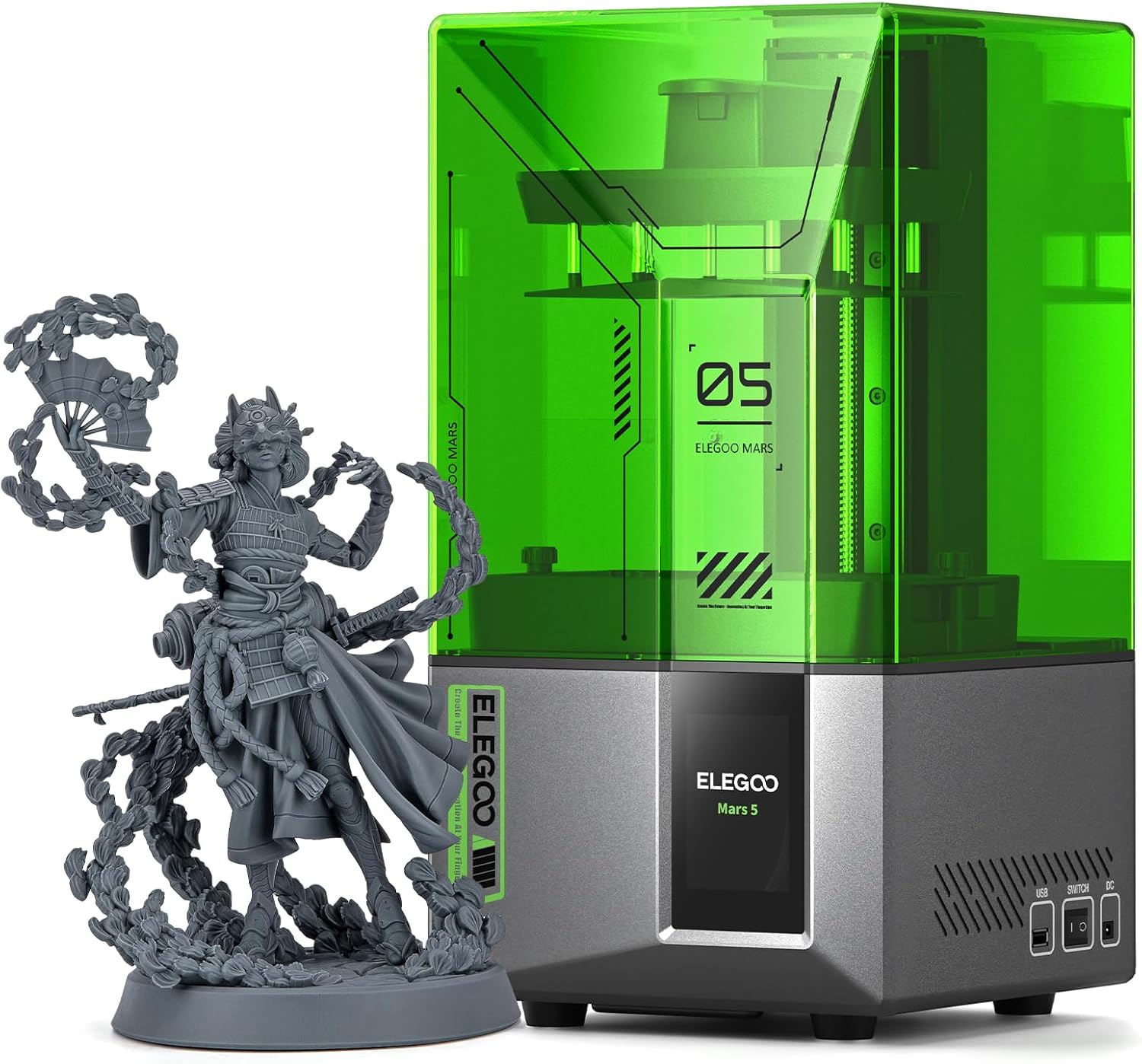
3. ELEGOO Mars 5 MSLA Resin 3D Printer
- Brand: ELEGOO
- Manufacturer: ELEGOO
Overview: The ELEGOO Mars 5 is a 4K MSLA resin printer with a 6.6-inch mono LCD, intelligent mechanical sensor, and automatic leveling. It emphasizes reliability and user-friendly safety features, including a built-in sensor that detects resin levels and potential errors before a print proceeds. The 4K resolution and COB light source promise sharp miniature details and consistent curing, making it well-suited for high-detail figurines and intricate sculpted parts.
In practical terms, the Mars 5 delivers high-resolution outputs with the 35 μm XY resolution and 4098×2560 pixel panel, which translates to fine line definition and smoother surfaces on minis. The automatic leveling and adjustable features reduce setup friction, while the cooling system supports longer print campaigns. Some users may find resin handling and post-processing requirements more involved than FDM, but for miniature enthusiasts chasing crisp features and thin detail lines, Mars 5 represents a strong value at its price point.
Pros
- 4K mono LCD provides exceptional detail for miniatures
- Intelligent automatic leveling reduces failed prints
- COB light source with high uniformity improves curing consistency
- Smart mechanical sensor enhances reliability and safety
Cons
- Resin handling, ventilation, and post-processing remain necessary
- MSLA printers require resin replacements and cleaner up methods
- Color and material options are constrained by resin ecosystem
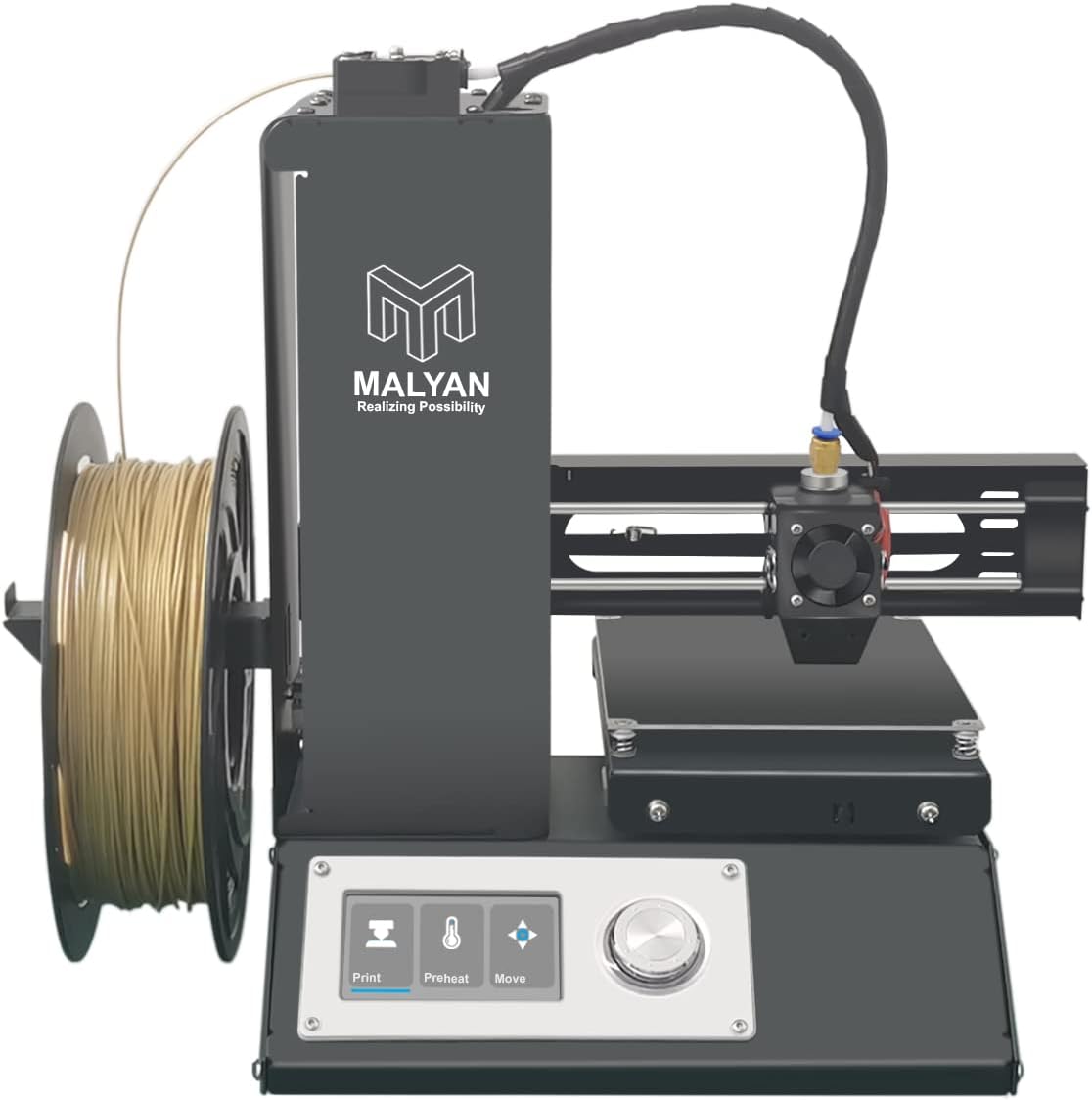
4. MALYAN M200 FDM Mini 3D Printer – Fully Assembled 3D Printers for Kids
- Brand: MALYAN
- Manufacturer: MALYAN
Overview: The MALYAN M200 is a compact, fully assembled FDM printer designed for beginners. Its small 120x120x120 mm build volume makes it ideal for quick, desk-friendly miniatures or test prints. The model ships with a sample PLA and preloaded microSD, aiming to lower entry barriers and accelerate early success. It features an all-metal hotend for temperature stability and a heated bed to improve first-layer adhesion, which is beneficial for small prints and modeling kits.
In practice, the M200 prioritizes ease-of-use over large-volume throughput. Its open-frame design provides visibility during printing, which helps new users observe and troubleshoot. While the all-metal hotend is a durability advantage, the overall print size is limiting for larger pieces or batch production. The 149.99 USD price point makes it compelling for beginners, though the FDM route will require more sanding and post-processing for a perfect miniature finish compared to resin options. It’s best for practice prints, learning the workflow, and creating functional miniatures or accessories where extremely fine surface finish is not required.
Pros
- Fully assembled and ready to print out of the box
- All-metal hotend supports stable high-temperature printing
- Heated bed improves bed adhesion for small parts
- Compact footprint suitable for desks and small spaces
Cons
- Limited build volume restricts large minis or terrain pieces
- FDM surface finish may require post-processing for ultra-fine details
- Open-frame design can expose prints to drafts or temperature fluctuations
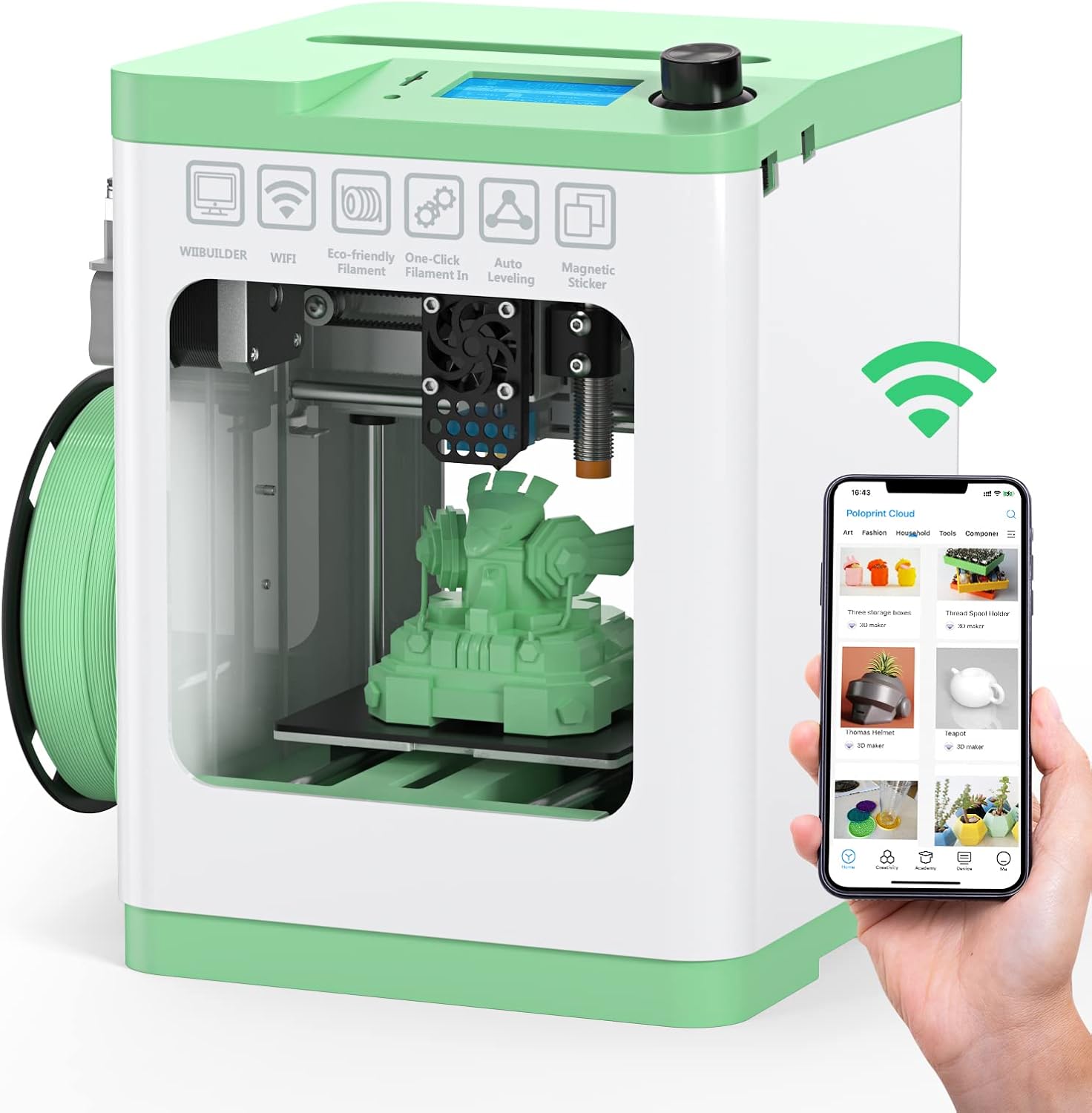
5. Tina2S V12 3D Printers with WiFi Cloud Printing
- Brand: Entina
- Manufacturer: Entina
Overview: The Entina Tina2S V12 targets newcomers and families with features like automatic leveling, built-in WiFi cloud printing, and a compact 9x9x13.8 inch footprint. It emphasizes smart control via an app and compatibility with Cura, Simplify3D, and Slic3r, offering flexible software workflows. The machine is fully assembled and includes a user-friendly experience with an emphasis on minimal setup and app-based file transfers.
In daily use, the Tina2S V12’s auto-leveling and heated bed streamline first-layer success, while the built-in LED lighting helps users monitor prints. The upgraded WiFi module promises faster file transfers, though real-world performance depends on network stability. The 3D printer’s quiet operation and dual-Z-axis guide design contribute to stable vertical motion, which matters for consistent layer alignment on small minis. As a value proposition, it competes strongly with resin options when considering total cost of ownership and material versatility, though fine-detail rendering will depend on the chosen workflow and nozzle/filament settings.
Pros
- Auto leveling and heated bed simplify setup and first layers
- WiFi/cloud printing enables convenient remote management
- App ecosystem supports various slicing software and model libraries
- Quiet operation with dual Z-axis guidance improves stability
Cons
- FDM printing generally cannot reach the crisp micro-detail of MSLA resin
- Reliance on app ecosystems may require ongoing internet access
- Build volume is modest for larger miniatures or terrains
Frequently Asked Questions
We’ve compiled answers to the most common questions about 3d printers to help you make an informed decision.
Conclusion
.
.
Final thoughts here.