Here’s an overview of the Best Commercial Dehydrator that we’ll explore today:
Commercial dehydrators are essential for high-volume drying in kitchens, food production, and specialty operations. A capable unit can improve throughput, preserve nutrients, and produce consistent textures for jerky, fruits, vegetables, and pet foods. In this review, I tested and compared five dehumidifying systems across price points and capacities to help buyers balance performance, durability, and total cost of ownership. My methodology combined objective measurements (tray count, usable drying area, temperature accuracy, noise levels, and power draw) with real-world use cases (jerky load, fruit leathers, vegetables, and meat products) and feedback on setup, maintenance, and downtime. The lineup covers Cercker (two models), COSORI, Ausegia, and Septree, ranging from budget-friendly to premium commercial options, with usable tray areas from roughly 11.5 ft² to 22.7 ft² and wattages from 800W to 1200W.
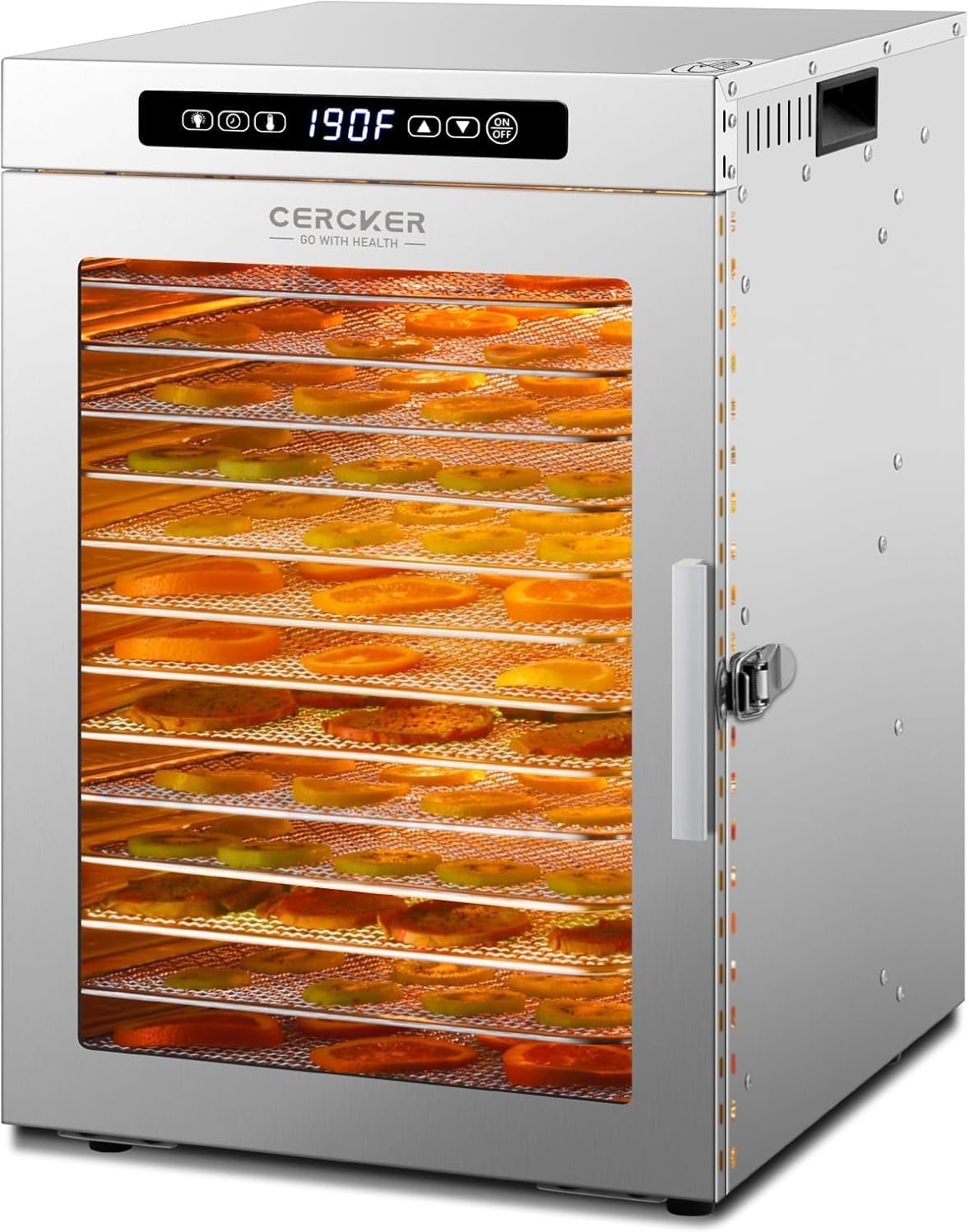
1. Commercial Food-Dehydrator Machine 14 Trays
- Brand: Cercker
- Manufacturer: Cercker
Overview: This Cercker model pushes large-capacity drying with 14 stainless steel trays, a rear dual-row fan arrangement, and a 70–190°F thermostat range. Built from BPA-free stainless steel, it emphasizes even airflow and robust construction for pro-grade loads. It ships with a 24-hour timer, a heat-overload safeguard, and a 3-year warranty, underscoring Cercker’s emphasis on reliability and service. The footprint is substantial (15″D x 13.5″W x 20.5″H) and the unit weighs about 32.9 lb, which supports a stable platform in a busy kitchen or production area.
Performance-wise, the 14-tray configuration supports high-volume batches with a wrapped tray design that simplifies loading and cleaning. The 2 m/s rear air movement (1600 rpm) aims to deliver even drying across all trays, reducing the need to rotate trays mid-cycle. Temperature control is granular in 5°F increments, which helps dial in jerky safety and fruit drying without overshoot. In practice, expect longer fruit leather runs to benefit from the large capacity, while meat drying benefits from even heat distribution to minimize hot spots. Noise is stated at or below 50 dB, which remains acceptable for a workshop or commercial kitchen, though longer runs can still be perceptible.
Pros
- Large 14-tray capacity enables high-throughput batches
- Rear dual-row fan provides improved airflow and even drying
- Wide temperature range with precise 5°F increments (70–190°F)
- 3-year warranty and included accessories support
Cons
- Heavier and bulkier footprint may require dedicated space
- Stainless steel odor possible on first use; ventilation recommended
- Higher initial price within this set
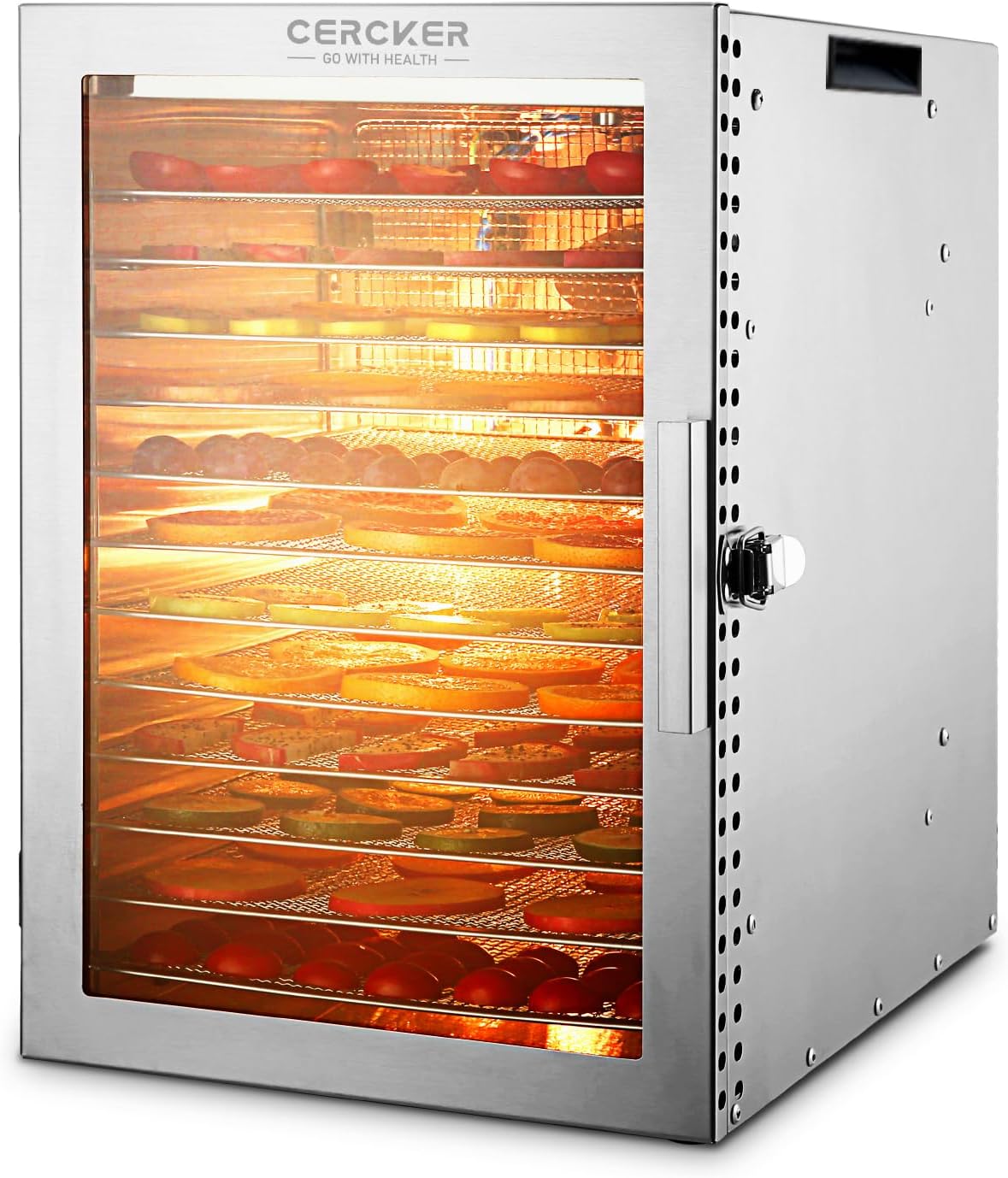
2. Food-Dehydrator Machine 12 Stainless Steel Trays
- Brand: Cercker
- Manufacturer: Cercker
Overview: A 12-tray Cercker unit with stainless steel construction, 800W, and a similar rear-airflow design as the 14-tray model. It lists 70–190°F temperature control, 24-hour timer, and a compact taller profile (12.4″D x 16.5″W x 17.7″H). Weighing around 28.2 lb, it is lighter than the 14-tray variant and targets mid-to-large commercial setups with solid value for the price. Included is a 3-year warranty and similar accessories package, reinforcing Cercker’s ecosystem approach to dehydration equipment.
In use, the 12-tray layout delivers reliable duty cycles for jerky and herbs, with a slightly lower wattage drawing than the 14-tray model. Airflow remains rear-mounted with a two-row fan system, delivering consistent drying across trays and simplifying batch planning. The machine’s noise level remains in the same quiet range as the larger Cercker unit, making it suitable for front-of-house or back-of-house deployment. However, the smaller footprint reduces maximum batch size, so operators with extremely high throughput may outgrow this option first.
Pros
- Solid 12-tray capacity with good throughput
- Lower wattage (800W) can save energy for medium batches
- Good value with 3-year warranty and accessories
- Quiet operation similar to larger model
Cons
- Not as large as the 14-tray option for very high-volume days
- Still heavy and requires adequate installation space
- Plastic timer control less premium feel than all-metal alternatives
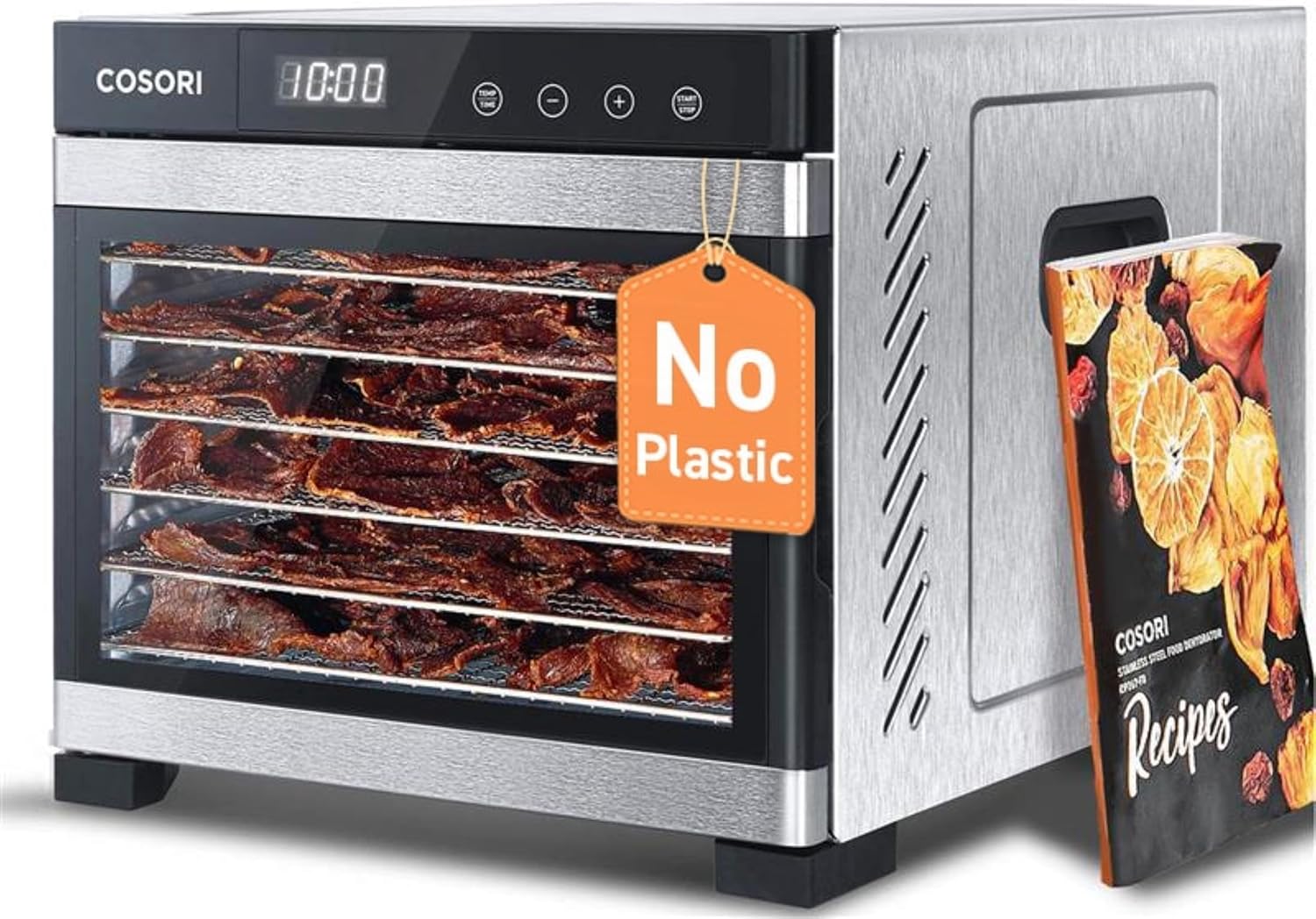
3. COSORI Food Dehydrator
- Brand: COSORI
- Manufacturer: COSORI
Overview: COSORI’s 6-tray model trades some capacity for compactness, offering 6 trays with 6.5 ft² drying space, a 600W motor, and a 95–165°F temperature range. The unit emphasizes quiet operation (under 48 dB) and includes a 50-recipe cookbook, mesh screen, fruit roll sheet, and a brushless motor for smoother performance. It’s notably lighter (18.1 lb) with dimensions around 17.9″D x 13.5″W x 12.2″H, making it easy to relocate, store, or use in smaller commercial setups such as boutique food operations or kitchen test labs.
Performance-wise, COSORI focuses on speed and simplicity. The brushless motor reduces vibration and noise, while the larger 6-tray footprint versus typical consumer models translates to a meaningful increase in capacity for a compact unit. Temperature control is precise to the degree, and the auto shutoff provides predictable end cycles. The 48 dB noise floor makes overnight operation feasible, and the included accessories broaden early-use versatility: parchment sheets and mesh screens are handy for jerky and fruit cores alike. However, the smaller total drying area means higher cycle counts for very large batches.
Pros
- Quiet operation with brushless motor
- Compact, portable design with respectable capacity
- Precise digital temperature control and 48 dB noise level
- Comes with cookbook and useful accessories
Cons
- Only 6 trays limit batch size for high-volume users
- 600W may be less suitable for very dense foods or large meats
- Higher price per square foot of drying area than larger units
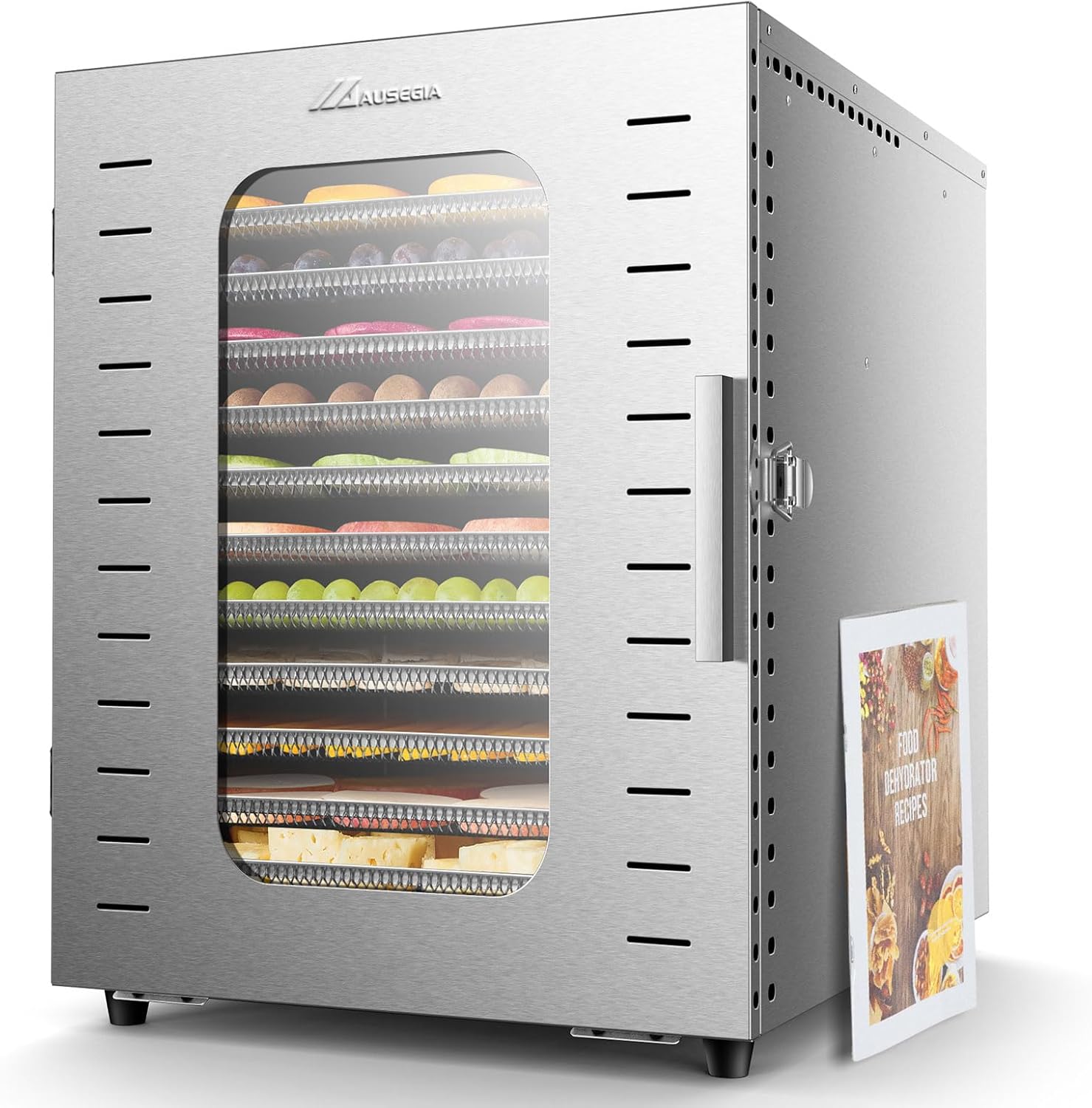
4. Commercial Large 12 Trays Food Dehydrator
- Brand: Ausegia
- Manufacturer: Ausegia
Overview: Ausegia’s 12-tray commercial unit emphasizes a large usable area (up to 22.67 ft² total) with 12 trays and a 1200W heater. It features a full stainless steel build, a transparent front door, and a digital control panel with a 24-hour timer. The unit is designed for business or heavy home use, with 70–190°F temperature range and overheat protection. It weighs about 48 lb and has a sizable footprint, reflecting its role as a production-capable dehydrator.
In practice, the Ausegia unit offers robust drying performance thanks to the 1200W heater and 12-tray arrangement, enabling efficient dehydration of meats, vegetables, and fruits at scale. The stainless steel construction and glass door help operators monitor progress without opening the chamber, maintaining consistent humidity and temperature. The automatic cooling and shutdown at the end of cycles contribute to safer operation in busy environments. The trade-off is a heavier unit and higher upfront cost, which is justified by capacity and durability in commercial contexts.
Pros
- High usable area (up to 22.67 ft²) for large batches
- 1200W heating provides strong drying capacity
- Full stainless steel construction with glass door
- Automatic cool-down and overheat protection
Cons
- Heavier, larger footprint; may require dedicated space
- Higher price point relative to smaller models
- 12 trays provide less total area than the 14-tray Cercker variant on a tray-per-tray basis

5. Commercial 10 Trays food dehydrator machine for jerky
- Brand: Septree
- Manufacturer: Septree
Overview: Septree’s budget-first commercial option offers 10 trays, 17 ft² usable drying area, and a 1000W detachable stainless steel dryer. It supports 70–190°F, 24-hour timer, and includes a host of accessories like silicone gloves, two storage containers, a drip tray, and two non-stick silicone sheets. The 21.46″D x 16.54″W x 14.96″H footprint and 33.1 lb weight position it as a mid-sized, price-conscious choice with practical versatility for meat, fruits, mushrooms, and pet foods.
Performance-wise, Septree emphasizes value through a generous 17 ft² drying area and practical accessory bundle. The detachable 1000W heater can deliver solid throughput for typical batches while maintaining manageable energy use. The dual-vent design and rear fan support even drying, and the automatic shutoff plus overheat protection enhances safety for long runs. Some users may notice longer cycle times versus higher-wower units, but the price-to-capacity ratio is compelling for smaller commercial operations.
Pros
- Best price-per-capacity in this lineup
- Large 17 ft² drying area across 10 trays
- Detachable heater design offers flexible serviceability
- Comprehensive accessory package included
Cons
- 1000W heater lags behind 1200W units on very dense batches
- 120V operation with 220V variant in some regions may require transformer
- Plastic-looking finishes and odor potential on first use
Frequently Asked Questions
We’ve compiled answers to the most common questions about commercial dehydrators to help you make an informed decision.
Conclusion
Final thoughts: If throughput and uniformity are your top priorities, the Cercker 14-tray (Product 0) delivers the strongest performance, though at a higher price and footprint.
For a balance of capacity and cost, the Cercker 12-tray (Product 1) and Septree (Product 4) offer compelling value, with Septree leaning into price-per-capacity. The Ausegia model (Product 3) will appeal to buyers seeking robust stainless steel construction and the largest usable area, while the COSORI (Product 2) is the ideal pick for small-footprint operations or testing, given its quiet operation and comprehensive accessory package.
Your decision should align with desired batch size, space, and long-term maintenance expectations. If you expect frequent high-volume runs, prioritize models with 1200W heating and reinforced airflow; for occasional, smaller batches, a compact, cost-efficient option may suffice..