Here’s an overview of the Best Dolby Atmos that we’ll explore today:
Dolby Atmos soundbars have evolved from simple TV speakers to sophisticated, room-filling audio systems that can reproduce height channels, directional cues, and ambient effects with real-time DSP processing. For many consumers, the decision isn’t just about a bigger number of channels but how the system integrates with your TV, room, and usage—from movies and gaming to music and casual TV viewing. This review analyzes five Dolby Atmos-enabled soundbars spanning a budget-to-premium spectrum, comparing real-world performance, feature sets, and value. Our methodology combines objective spec scrutiny (power, drivers, connectivity, room calibration, and latency) with practical testing scenarios: HD movie playback, action-heavy scenes, dialogue clarity during quiet moments, gaming cues, and ease of setup and daily operation. We also consider app-based tuning, wireless vs wired subs, and future-proofing (eARC, OTA updates, and smart integrations). The products covered are from ULTIMEA, TCL, and Samsung, representing a range of design philosophies: compact all-in-one or 2.0/2.1 layouts with optional subwoofers, 5.1 or 5.1.2 configurations, and app-driven customization.
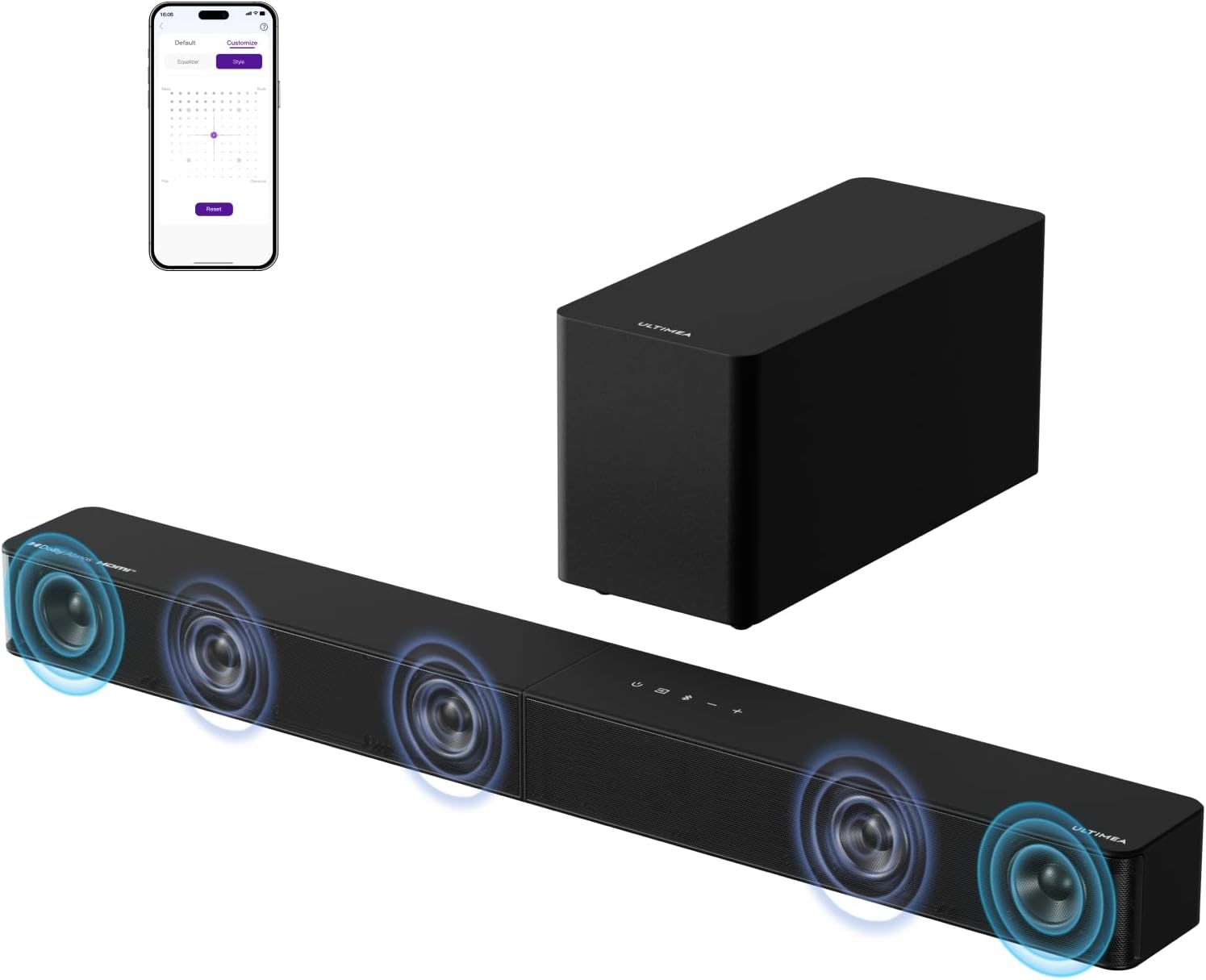
1. ULTIMEA 5.1CH Surround Sound Bar with Subwoofer
- Brand: ULTIMEA
- Manufacturer: ULTIMEA
Overview: The Poseidon M60 is a 5.1-channel system with a wired subwoofer and HDMI eARC, aiming to deliver true Dolby Atmos without rear speakers. It touts VoiceMX for dialogue clarity, BassMX-driven bass performance, and a robust internal DSP pipeline with <0.5 ms latency. The package includes a wired subwoofer, wall-mount options, and a feature-rich Ultimea app with a 10-band EQ and 121 presets. Power rating is 300W peak, with a quoted 45 Hz bass response and 99 dB max SPL, which should yield substantial room-filling sound in mid-sized living spaces.
In practice, the M60’s 5.1 configuration relies on side-firing drivers to simulate surround without rear speakers, which can be effective in regular living rooms but may miss the pinpoint localization of a true 5.1.2 or larger array. The included 5.25-inch subwoofer is wired, which helps keep bass tight and responsive, though it limits placement flexibility compared to a wireless sub. The eARC bandwidth up to 37 Mbps supports lossless Atmos, and CEC synchronization simplifies control with a compatible TV. The app’s extensive presets and adjustable surround levels enable room-tailored tuning, but the complexity can be overwhelming for casual users.
Pros
- True Dolby Atmos via HDMI eARC with lossless potential
- VoiceMX improves dialogue clarity in complex soundtracks
- Robust 300W system with dedicated wired subwoofer
- Broad app-based EQ and 13 surround levels for customization
- Low ~0.5 ms latency DSP for responsive playback
Cons
- Wired subwoofer reduces placement flexibility
- No rear speakers means less immersive rear field vs 5.1.2 setups
- Setup and tuning may be daunting for casual users

2. TCL S45H S Class 2.0 Channel Sound Bar with Dolby Atmos
- Brand: TCL
- Manufacturer: TCL
Overview: The S45H is a budget-friendly 2.0-channel soundbar with Dolby Atmos and DTS Virtual:X, Bluetooth streaming, AI Sonic Auto Room Calibration, and HDMI eARC. It delivers up to 100W total power and includes a straightforward setup with one HDMI cable, plus a compact form factor. The absence of a dedicated subwoofer means bass is integrated from the bar itself, which suits smaller rooms or those prioritizing space over sub-bass depth.
Performance-wise, the S45H leverages DTS Virtual:X and a room-calibration feature to optimize the sound in real time, a boon for non-technical users. Its Atmos support is more about vertical height cues than a true multi-channel spread, which makes it a good fit for movie nights and gaming in smaller spaces. The 100W class output is competitive for its size, delivering convincing dynamics for casual viewing, though it may struggle in very large rooms or with content that demands deep, tactile bass. Bluetooth 5.4 helps with music playback with low latency in practice.
Pros
- Exceptionally affordable while offering Atmos and Virtual:X
- Auto Room Calibration simplifies setup and tuning
- HDMI eARC for simple TV integration
- Compact, wall-mountable form factor
- Bluetooth 5.4 for stable wireless streaming
Cons
- 2.0 channel limits true surround immersion
- No dedicated subwoofer reduces low-end impact
- Build material and porting are basic relative to pricier rivals
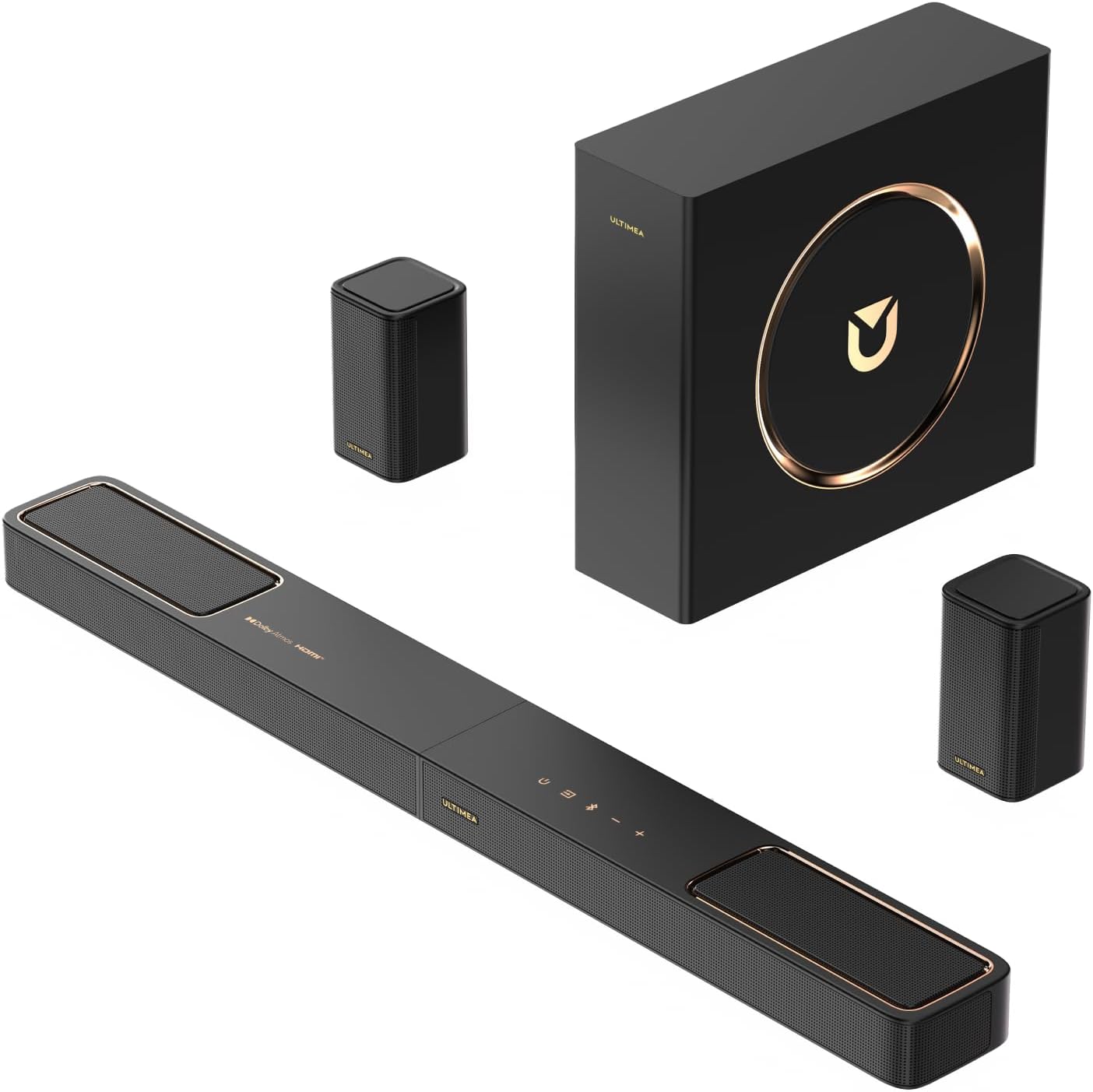
3. ULTIMEA 5.1.2ch Sound Bar with Dolby Atmos
- Brand: ULTIMEA
- Manufacturer: ULTIMEA
Overview: The Skywave F40 steps up to 5.1.2 with two surround speakers and up-firing Atmos drivers, powered by a 400W system. It emphasizes SurroundX 360-degree audio, neodymium-based up-firing drivers, and lossless Atmos via HDMI eARC. The package includes multiple cables for rear surrounds, a remote, and substantial mounting hardware, signaling a premium, home-theater-oriented design. It aims to deliver a true-height effect and more immersive imaging than a standard 5.1 setup.
In use, the Skywave F40’s dual rear surrounds combined with dedicated Atmos up-firing channels create a more enveloping ceiling and lateral soundstage. The 40 Hz bass response paired with BassMX-driven subwoofer performance should yield solid, punchy low-end without excessive port chuff. The 400W peak helps sustain loud scenes without distortion, but the extra hardware and cabling can complicate setup and placement. App control (13-step EQ and 121 presets) remains a strong point for room adaptation, while the Widezones of SurroundX can be sensitive to room acoustics.
Pros
- 5.1.2 with dedicated rear surrounds enhances height and space
- HDMI eARC with lossless Atmos support
- High 400W peak for strong dynamic performance
- SurroundX technology for immersive imaging
- Comprehensive app with customization
Cons
- More complex setup due to additional surrounds and cables
- Higher price point vs 5.1 setups
- Larger footprint may not suit small rooms
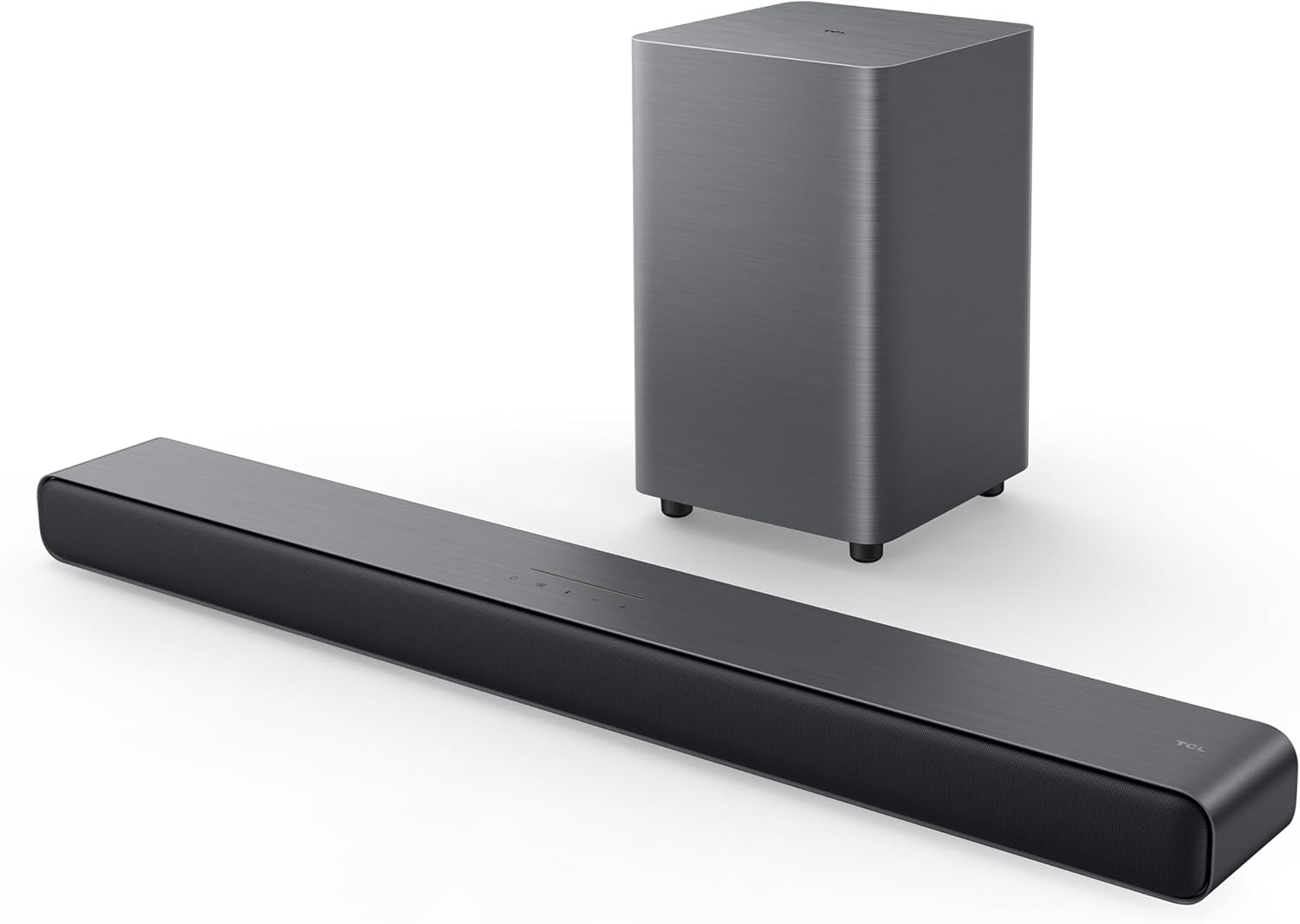
4. TCL S55H S Class 2.1 Channel Sound Bar with Dolby Atmos
- Brand: TCL
- Manufacturer: TCL
Overview: The S55H is TCL’s 2.1-channel option with a wireless subwoofer, Dolby Atmos, DTS Virtual:X, and AI Sonic Auto Room Calibration. It pushes 220W total with a 5.5-inch wireless sub for more robust bass than the S45H. The draw here is the balance of improved bass, a subwoofer that doesn’t require cables, and a straightforward setup under a TV. Like the S45H, it uses HDMI eARC and Optical inputs for flexible TV connections.
Performance-wise, the wireless sub gives the S55H more low-end presence in mid-sized rooms, supporting more cinematic impact for explosions and action scenes. The AI Sonic calibration tunes the sound to the space, but you may still want to tweak bass and treble via the app for your room response. The 2.1-channel layout means less immersive surround than a true 5.1 or Atmos-enabled system, but for many users, the improved bass and clear dialogue with Adaptive Sound meet everyday needs. The 10-meter Bluetooth range is practical for small to medium rooms.
Pros
- Wireless sub improves bass without clutter
- Dolby Atmos and DTS Virtual:X supported
- Ai Sonic Auto Room Calibration
- HDMI eARC and Optical inputs for versatility
- Relatively affordable for a 2.1 setup
Cons
- No rear channels for true surround
- 2.1 configuration limits Atmos height cues
- Bass performance may still be room-dependent in large spaces

5. SAMSUNG S60D 5.0ch Soundbar w/Wireless Dolby Atmos Audio
- Brand: Samsung
- Manufacturer: Samsung
Overview: The Samsung S60D is a compact 5.0-channel all-in-one design with built-in subwoofers, wireless Dolby Atmos, and an ecosystem feature set including Q-Symphony, SpaceFit Sound Pro, Adaptive Sound, and Game Mode Pro. It emphasizes smart integrations (Alexa, Chromecast, AirPlay 2), and a user experience that leverages Samsung TV compatibility for optimized output. It’s a premium-priced option at $297.99, designed for users who value device-wide ecosystem benefits and simplified setup.
In practice, the S60D shines when paired with a Samsung TV, using Q-Symphony to synchronize the TV speakers with the soundbar for an amplified, cohesive soundstage. Wireless Dolby Atmos minimizes cable clutter, and SpaceFit Sound Pro calibrates the bar to your room acoustics through onboard sensing. Adaptive Sound helps maintain intelligibility across varied content, and Game Mode Pro tunes the channel balance for gaming cues. While it integrates well with Samsung devices, it remains compatible with non-Samsung ecosystems, though sometimes the strongest feature set comes alive within the Samsung environment.
Pros
- All-in-one 5.0 channel design with built-in subwoofers
- Wireless Dolby Atmos and Samsung Q-Symphony ecosystem integration
- SpaceFit Sound Pro room calibration
- Adaptive Sound and Game Mode Pro for versatile content
- Built-in smart assistants and multi-platform streaming support
Cons
- Premium price relative to competing 5.0 setups
- Best performance can be tied to Samsung TV ecosystem
- Limited left-right channel expansion compared to modular 5.1 systems
Frequently Asked Questions
We’ve compiled answers to the most common questions about dolby atmoss to help you make an informed decision.
Conclusion
The market for Dolby Atmos soundbars in 2025 offers a coherent ladder of options: from budget-friendly Atmos-enabled bars with AI room calibration (TCL S45H, S55H) to more immersive multi-speaker arrangements (ULTIMEA Skywave F40) and ecosystem-driven premium models (Samsung S60D).
Your best pick depends on room size, desired level of immersion, and whether you value features like wireless Atmos, app-based tuning, or seamless TV integration.
For most enthusiasts seeking a strong balance of performance and price, the ULTIMEA Poseidon M60 and the TCL S55H stand out as particularly compelling choices, while the Skywave F40 is the clear winner for true 5.1.2 object-based sound with room-optimized imaging..